
Education
My broken record, yet again

The Vermont Agency of Education recently released the results of the 2024-25 Vermont Comprehensive Assessment Program (VTCAP) tests. Here are some results, as highlighted in the Agency’s press release:
There was basically no change in the results from the previous year.
In English and Language Arts (ELA), which tests reading comprehension, depending on the grade between 46% and 61% of students were proficient. That is, nearly half of Vermont students cannot read and understand what they should at their grade level.
In mathematics, between 33% and 48% of students were proficient, which means that more than half, and as many as two-thirds, were not performing at grade-level expectations.
In science, between 41% and 45% of students were proficient. More than half were not.
Students from historically marginalized groups performed far worse.
Those percentages are somewhat higher than the results of the 2024 National Assessment of Educational Progress (NAEP) scores for Vermont, which found that between 30% and 40% of Vermont students tested scored proficient or better.
The VTCAP tests are given to all Vermont students. But only about a dozen other states use those tests so we can’t compare Vermont student results to most states. The NAEP tests are given to a sample of students in all states, so we can use NAEP results to compare Vermont student performance, as I have reported elsewhere.
Broadly, both tests find that there is room for vast improvement, and both find that students from subgroups that would benefit from better education exhibited far worse performance than the average Vermont student.
Vermont’s state and local governments spend nearly $2.5 billion on elementary and secondary education and that spending accounts for more than 40 percent of all the taxes Vermont’s state and local governments collect.
You would think—and I believe—that what we get for that money would be a major concern.
I have written about both spending and the results of that spending here and here. But I seem to be a lone voice in the wilderness. I could find no mention of those state results on Vermont Public’s website, or in VTDigger, or in the Burlington Free Press. To its credit, at least Vermont Business Magazine reprinted the press release.
WCAX did run a story on the results. It focused mainly on the worse-than-average results from historically marginalized groups, which the Education Agency defines as minorities, poor students, recent immigrants, students from homeless families, and students from military families. (I don’t want to editorialize too much, but I’m not sure members of the Vermont National Guard would say that they are a marginalized group in Vermont.)
It also contained an unusual quote from the president of the Vermont NEA. He apparently did not find the overall poor results surprising, since “our students have grown up in a toxic culture.” I guess that’s a convenient scapegoat for poor educational performance, but I would hope our teachers are better than that.
The lack of interest from most of the state’s major media outlets is disappointing. In the past month, VTDigger has run several articles and opinion pieces on a variety of education topics, but not this one. The same holds for Vermont Public (Radio) news. Apparently issues such as the consolidation of two rural high schools are more newsworthy than poor and declining overall education quality.
Given the large amount of taxpayer dollars spent on education, and that Vermont outspends 48 states on a per pupil basis, that we get very poor results should be a major concern to Vermonters. But if the media don’t tell us about it, how are we expected to know?
The Boston Globe recently published an in-depth feature article titled New England Schools are Failing--and Nobody Seems to Care. (Clicking on the link will bring you to an offer to subscribe to the Globe in order to read the article, and it’s worth the $1 for six months subscription rate to read it.) The article focuses on Vermont, Maine, Mississippi, and Louisiana—two states that used to have high measures of education performance but are now poor, and two with historically low scores that are now high and rising.
Can you guess which states are in each category?
Louisiana’s improvement has come despite having one of the highest poverty rates in the nation. Maybe despite their poverty, Louisiana students don’t grow up in a “toxic culture” which makes it easier for them to achieve higher levels of performance. Or maybe Louisiana policymakers have implemented policies that work.
The day after the Globe article appeared, the Vermont Agency of Education responded with a press release highlighting the steps Vermont is taking to improve public education, which in turn prompted an article in the Globe. (Stay tuned for more in the Boston Globe vs Vermont Agency of Education battle of words.)
In what is almost a parody of how Vermont government deals with a host of issues, the Agency of Education’s press release highlighted the steps Vermont is taking to improve education. It has
Reorganized itself
Engaged with leaders
Defined a path forward
Published a report on special education
Worked with groups to develop statewide graduation requirements
Impressive, I guess.
Compare that to specific actions Mississippi has taken to improve education in the last decade:
The state allocated $15 million to train 8,000 teachers in reading instruction.
60 literacy coaches work with the state’s lowest performing schools.
A law funding pre-K included requirements for literacy skills as a prerequisite for 3rd grade graduation.
Provided incentive pay for teachers whose students show marked improvement.
According to the Urban Institute, demographically adjusted NAEP test scores in Vermont are now among the lowest in the country. Mississippi and Louisiana students now perform better than Massachusetts, which used to be at the top of the rankings.
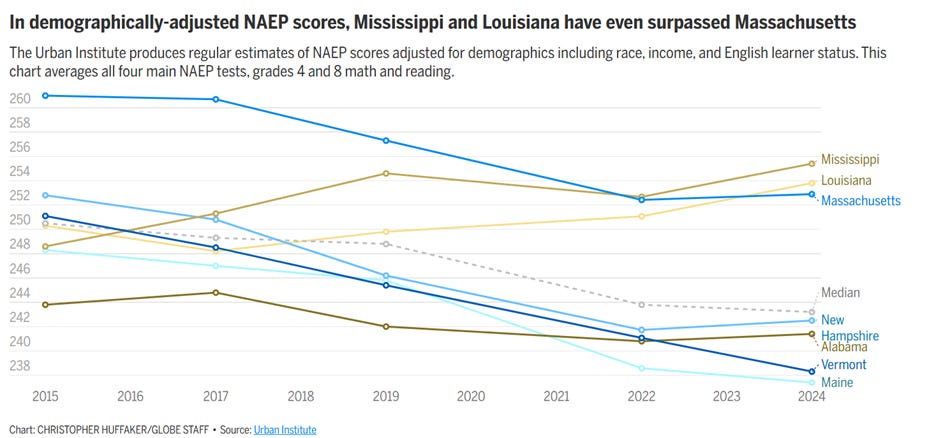
Louisiana does this while spending 45% less per pupil than Vermont. Mississippi spends 58% less. That difference translates into more than $1 billion in education spending.
Although I repeat myself, it is appalling when the single largest pot of taxpayer money leads to such mediocre results. And it doesn’t matter whether we are looking at the federal NAEP test or the state’s VTCAP. Half of Vermont students don’t perform at grade level expectations. And it’s even worse for students from historically marginalized groups, who would benefit from a high quality education much more than students from middle and upper income families.
That this isn’t covered by the state’s media, and is not a major concern, or even a topic of discussion in Montpelier, in the state’s business community, or anywhere else is a sad commentary on Vermont. And an even sadder commentary on the state’s future.
Note: After I posted this I saw that Governor Scott is using Vermont’s poor educational performance as reason to support Act 73.
Keep up the good work. At some point, someone with the authority to make changes will listen and take action.